





By Cathy Manso
In this Q&A interview with OPC Governor and producer Juan Arredondo, we explore the documentary, “Armed with Only a Camera: The Life and Death of Brent Renaud.” It premiered earlier this year at South by Southwest (SXSW) and received widespread acclaim for its intimate portrayal of Brent’s life and the immense sacrifices journalists make in conflict zones.
Recently, it concluded an intensive week of screenings and panel discussions in New York featuring director Craig Renaud, producer Juan Arredondo, and executive producer Jon Alpert, along with journalist Sharif Abdel Kouddous. The events were moderated by a lineup including Committee to Protect Journalist CEO Jodie Ginsberg, Democracy Now!’s Amy Goodman, Foley Foundation’s Tom Durkin and OPC member Lauren Walsh, Professor and Director of the Photojournalism Intensive at New York University. This documentary not only honors Brent Renaud’s legacy but also pays tribute to fallen journalists worldwide, shedding light on the emotional and physical toll of frontline reporting.
“Armed with Only a Camera” will be available to stream on HBO starting October 21.
This interview has been edited for length and clarity.
Q: How did you get involved as a producer in the documentary “Armed with Only a Camera, The Life and Death of Brent Renaud”?
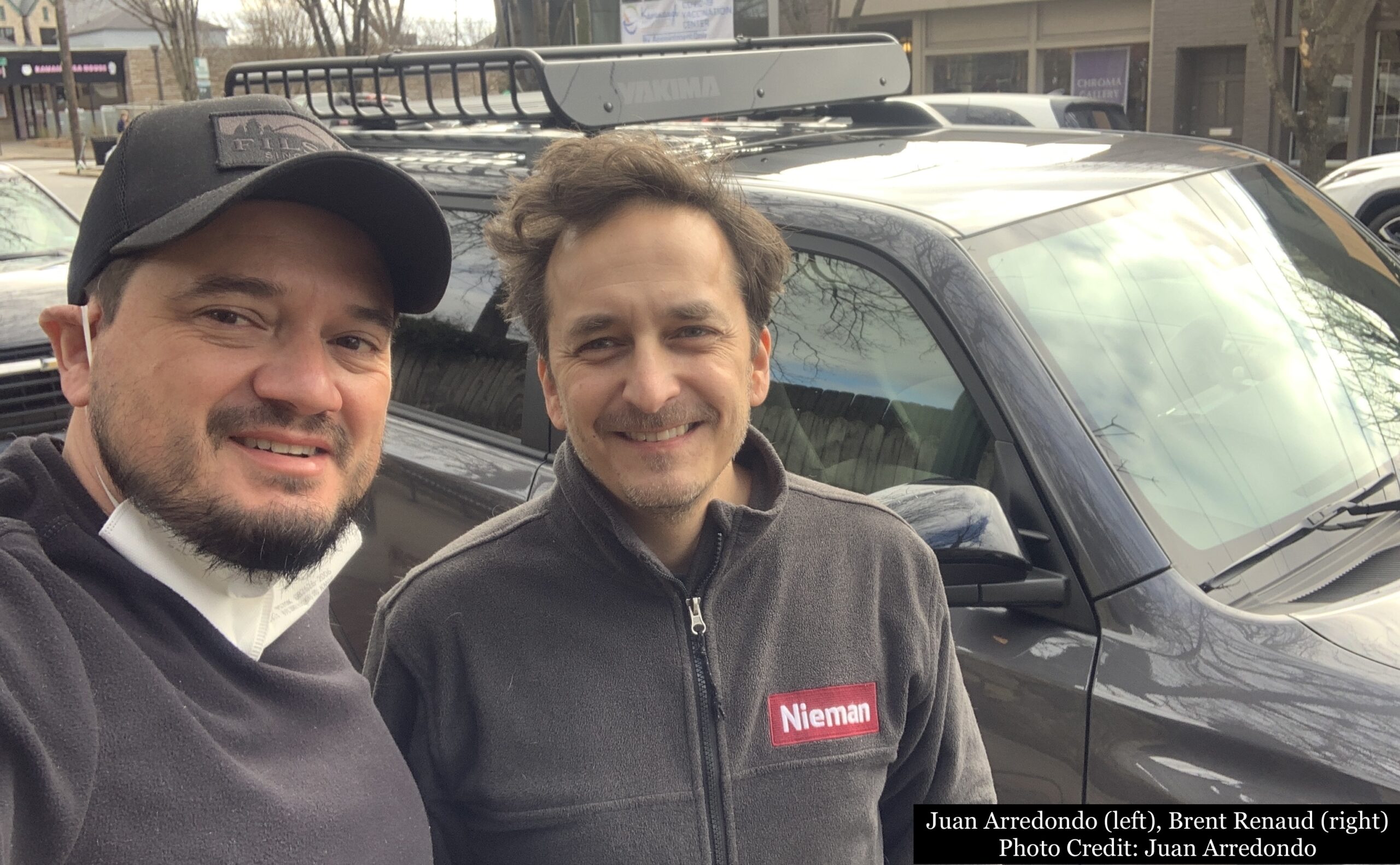
Juan Arredondo: I met Brent at the Neiman Foundation in 2018. In 2020, we started working together on documentaries about refugees. When the Russian invasion of Ukraine began in February of 2022, we quickly saw that was more relevant. It was immediate. And it was displacement and refugees. The numbers were swelling fairly fast. So by the second week, we were there entering Ukraine. Our journey took us to Kyiv. We went outside Kyiv to Irpin and we were trying to get to Bucha and that’s when we were attacked. My friend lost his life and I was injured.
The moment that happened, Craig, Brent’s brother, flew in to get his brother’s body out and helped me evacuate. Craig started filming his trip, arriving in Kyiv. From that moment on, I think we were conscious that we wanted to document this. We weren’t sure if we were going to make a documentary about it, but I think it’s sort of that innate reaction to document what’s happening. I quickly realized that I was now on the other side of the story that I was telling. I began to record myself, in voice notes and videos. A couple of months after that Craig pitched this to HBO.
I went back to Ukraine a year after our attack. I met with the driver who took us that day. I took the same route that Brent and I did when we traveled at that time. And that didn’t make it into the documentary. We just kept working on it. So from the beginning, I was part of it. I was involved as a subject and helped film, photograph, edit, and produce the documentary.
Q: As you said, you’re on the other side of the story. As an individual and as a foreign journalist, how did this impact you?
Juan Arredondo: Deeply in many ways. I cover conflicts in other parts of the world, mainly in Latin America. It was never to the scale of what I saw in Ukraine. It affected me because I was injured. I underwent 13 surgeries to recover. At one point, my leg was not responding and I thought I wasn’t going to be able to walk. It took months of physical therapy to be able to walk again.
It’s the emotional toll of losing your wingman, losing your partner, your friend from work, my colleague, and who at the same time was my mentor. There are two components; there’s the physical part, which luckily I am now healthy and fully recovered, then there’s the emotional and personal part that affects us who do this sort of work.
I feel that I bonded very closely to Craig. I always say I lost a friend but I gained a brother. That has brought us together, has brought me closer with his family. And we are supporting each other throughout this process. There are ups and downs. Trauma can express itself in many ways. It’s a wound that heals very slowly, and there are times that it will reopen. You just have to be mindful of that.
Q: Over these last few years, what was the challenge that surprised you most during this documentary process?
Juan Arredondo: Brent was a very private person and we were very close friends, but there were aspects of his life that I didn’t really know because he just didn’t share those parts of him. Craig and I went through 20 years of his archives. We were trying to find his voice. As we often do, we never turn the camera on ourselves. We just go. It’s about the story, our collaborators and how we can best tell the story. So that was one of the challenges, finding his voice.
The film for me was very revealing of the way they worked and the way Brent worked. He kept very detailed and copious diaries. There were moments I felt I was invading my friend’s privacy. I would go to Craig and say, ‘I can’t, I don’t feel comfortable with this,’ but the family always encouraged me and said if there’s anyone we trust with this information, it is you.
In that process, I learned more about Brent. Also, I spent months living with Craig to help him with the edit. That brought us together in many ways. We would try to diffuse the tension, either going running or biking. It was difficult seeing Brent. In one scene, he’s alive and going about filming. Then in another scene, he’s dead. That took an emotional toll and we were both mindful of that.
Q: What are your happiest memories with Brent?
Juan Arredondo: We have so many. When we started our Nieman fellowship, he would miss a lot of the activities that were put in place for fellows. It’s a very tight schedule. Sometimes he would miss those activities. At the time I thought, ‘Wow, what an ungrateful person,’ to be given this opportunity and miss it. Then one day he called me and said, ‘Hey, Juan, I lost my keys and I’m locked out of the house. Can I stay over at yours?’ And that’s when I realized that Brent was mentally somewhere else. He was trying to participate socially, but at the same time trying to catch up with the demands of the fellowship. Brent struggled with social integration and sometimes missed activities, which I later understood was due to his autism diagnosis. I found out his bed was a sleeping bag and I still remember helping him find furniture. And those little things always made me laugh. You could also see him grow as a person and take chances. He did stand-up comedy while he was in Cambridge. He was just a funny person; of course, it was an acquired taste.
I also remember one time we were doing a story in Venezuela on the border. We were trying to do this 360-degree video of people crossing the bridge illegally into Colombia. There was a contraband group that was trying to steal our cameras. We had to wrestle with them, cover our cameras and then run away because they were going to pull guns on us.
At the end you’re just sitting with a coffee and laughing at all the stuff that happened. And that’s how I want to remember him.
Q: To the average audience member, you’re exposing them to a world they’re not used to but for journalists there are many moments that are relatable. What do you think a foreign correspondent is going to take from watching your documentary?
Juan Arredondo: I hope they appreciate the level of intimacy that the documentary exposes and shows. Part of it is telling Brent’s story but also the journey of his brother, who has been his lifelong partner in crime. Like we said many times in our panels, whatever happens, we will never leave the other behind, and it’s Craig going back to get his brother. A lot of people probably don’t understand that. And I can say that because I’m asked the same questions every time we screen this film: why do you keep going back? Why do you expose yourself to this? My answer to that is, we have to be there to make sure that history is not rewritten or erased. I feel like that is where I find myself to be useful. That is where I can really use my skills to give others a voice. Hopefully, what you can get out of this film is the dedication Brent had. He spent many years going back to Haiti, going to Somalia, spending a year with the National Guard when first deployed to Iraq. Craig and Brent were probably the first people who were embedded for that long. And being able to tell the story not only from the perspective of soldiers, but from their families back home.
I think people don’t appreciate the amount of effort and time that you have to spend out in the field, away from family and friends. But the end result, hopefully, is making people aware and telling stories about those areas where we wouldn’t get information. If it weren’t for journalists who go abroad, we wouldn’t know what was happening in some of these areas and certainly viewers might not know about conflicts in other parts of the world.
I hope that they see themselves reflected in the film. It’s a tribute to the fallen journalists. There have been so many after Brent’s death, especially this last year and not only from the conflict in Ukraine but also the conflict in Gaza and those numbers keep growing. And that’s something that I know we’re not going to stop with the film but I hope it raises awareness on the importance of the work we do.
Q: Has this changed how you approach other stories?
Juan Arredondo: I’ve learned to appreciate life more and I’ve learned to appreciate the work that I do more. I feel more passionate about it, especially given the times that we’re living through right now here in the US and abroad. I think that we have to continue to do our work. And despite what happened, my friend dying and me being injured, it has forced me to refocus by saying I want to continue doing this work. Has my approach changed? I think not. I think it’s still the same. I now like to take deeper dives. I think there is value in that. Obviously, there’s less and less funding for that type of journalism, but I still have editors who believe in what I do and see value in that. So I’ll keep going out. I’ll keep going and telling stories.
It’s always about risk assessment. As much as we want to control everything, there’s always an element of risk. We try to minimize that by having more intel about where we’re going, understanding the situation, taking all the precautions. There’s always that chance that things can go wrong. And unfortunately for us, that was in Ukraine. That’s not to say that it will happen again, but that’s not shying away from telling these stories.
Q: The OPC has a whole new set of students who will be reading this and I wanted to ask what advice would you give our new generation of students who are considering reporting in conflict zones?
Juan Arredondo: Really understand the area. Avoid ‘parachuting journalism’ where you briefly land, report, and leave. Some of us are tempted to do this because we want to make our career. There are now more resources available to do this in a safer way. When I was first starting out, there weren’t any of those resources. Learn from your peers and always reach out to others. This is a competitive profession. Everyone’s very compassionate about giving advice or helping someone who started out in this field. So look for mentorship, look for others that have more experience. And the last thing, be mindful not to cause harm to the communities you report on, since the consequences stay with them after journalists leave.
Q: What’s your favorite part of the documentary, “Armed with Only a Camera, The Life and Death of Brent Renaud”?
Juan Arredondo: There’s a moment where Brent goes to Somalia. There’s one of the largest car bombs that detonates in the capital. It’s a scene of carnage, but they go back into the hospital, he passes through one of the wards, and there’s a man. You can clearly see him. His hands are burned. His face is burned, but he calls out and says, “What’s your name?” And he responds, “Oh, my name is Brent.” And the burn victim says, “The way you’re holding that camera, you’re doing it from your heart.” And that moment sort of always strikes me. He was able to see Brent and the way he was working. This man felt compassion in what Brent was trying to do, to be there in that moment and to tell those people’s stories. I like that scene so much because it’s just something that is unexpected and to have that on film. We’re lucky that Brent didn’t stop rolling. And that was probably one of the challenges of this film, finding those little nuggets, those moments of humanity and compassion that Brent had and what he was filming.
Q: I know you just had a long week of Q&A’s and screenings. Is there a question you haven’t been asked that you wish you could answer?
Juan Arredondo: I think you actually asked me, which was, what were my happiest moments with Brent? The film is heavy. It’s difficult to watch. It’s emotionally charged. It has graphic content. People might walk out of the theater after watching the film and have that image of Brent. And so I appreciate it when very few, including you, have asked me how I remember him because that’s not the Brent I want to remember. I want to remember the happy moments. That question doesn’t come up very often, maybe because of the timing, maybe because the panels are short. Maybe because, I don’t want to say shock but, you can tell in their faces they just watched something that’s difficult to watch. And when you start the panels, there’s a quiet moment and it’s hard to break that moment.
The other question that no one has asked– not me but Craig– is what is it like to work with your brother. I don’t have brothers. I’ve always been sort of this one-man band. And so I don’t know what that relationship is like. To be able to work with your brother for such a long time in very difficult situations. I haven’t seen anyone ask that question. And I’m curious because I might know the answer, but putting him on the spot would be something that I want to know.