Event Coverage Highlight

Overseas Press Club Annual Awards Dinner Honors Journalists Amid Rising Global Threats
NEW YORK, April 21, 2026
by Jack Stone Truitt
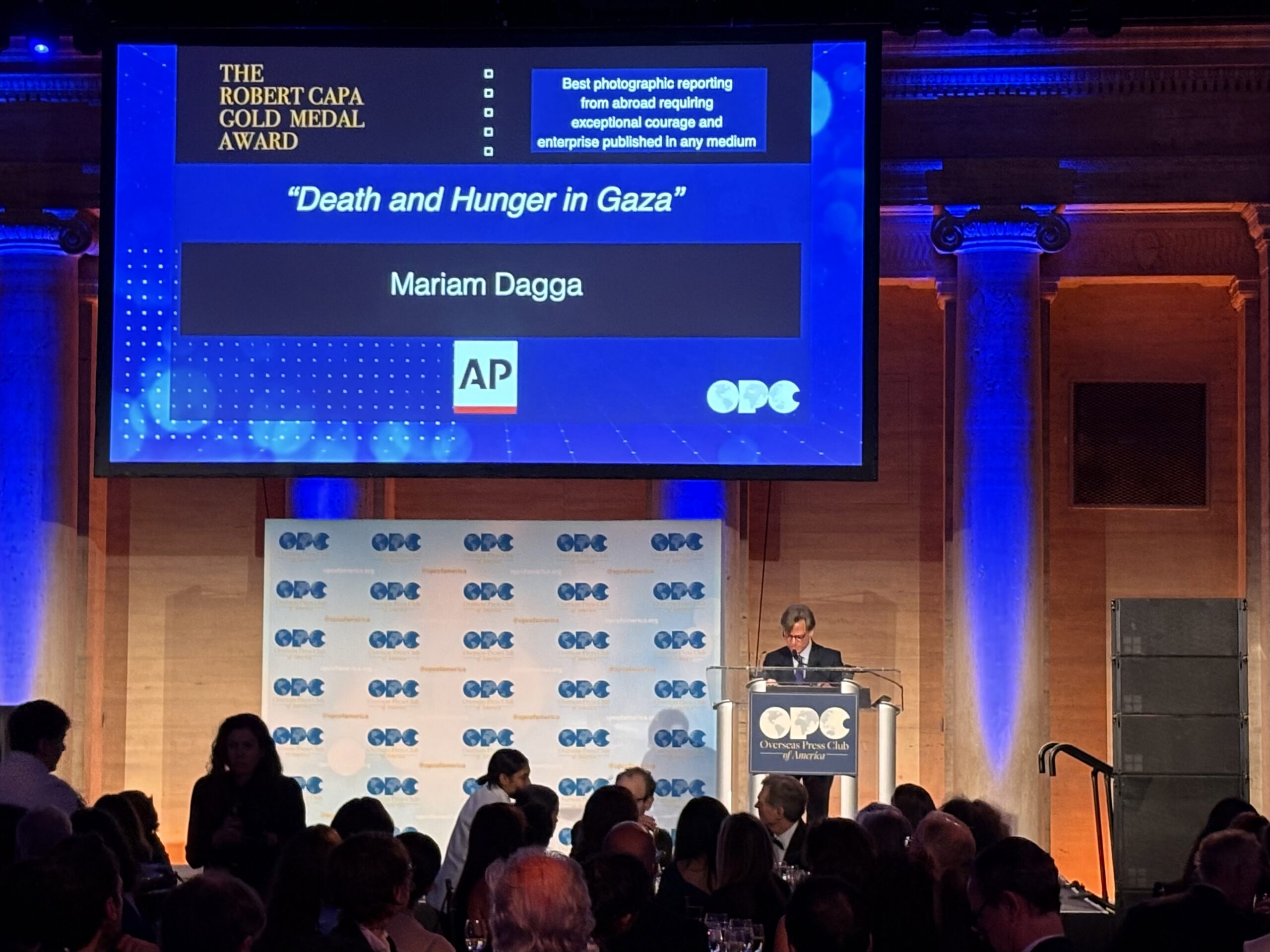
Photo by Brian Byrd
International correspondents and their colleagues gathered in New York City on April 20 for the Overseas Press Club of America’s 87th Annual Awards Dinner to honor outstanding work from another deadly year for journalists across the globe, while technological changes upend longstanding means of producing and sharing information, and embolden regimes intent on suppressing the media.
“While the speed of our dispatches has accelerated over the years, so too have the efforts of those who seek to shroud the truth. Yet as tonight’s winners demonstrate, we refuse to look away,” said OPC President Scott Kraft in his opening remarks.
“This work has never been more vital, and it has never been better. But we must also acknowledge a harder truth: it has rarely been more perilous, nor its mission more contested,” he said.
A record 129 journalists and media workers were killed in 2025, according to the Committee to Protect Journalists, the second year in a row for record deaths since the CPJ began collecting such data in 1992. Two-thirds of those deaths occurred in Gaza, but wars in Sudan and Ukraine have also seen increased danger to the profession.
One of those lost in 2025 was Mariam Dagga, a 33-year-old Associated Press photojournalist killed in an Israeli attack on a hospital and a 2026 OPC award winner.
Julie Pace, executive editor of the AP, continued the OPC tradition of lighting the Press Freedom Candle honoring journalists like Mariam who have been killed, injured, or imprisoned in the past year.
Pace also served as keynote speaker for this year’s ceremony and recalled going through Dagga’s photos for a story on children in Gaza suffering from extreme hunger.
“Mariam’s reporting and her photos had a real impact around the world. And we’re so grateful that it was honored tonight with the Robert Capa gold medal. But as you know, Mariam wasn’t here to accept that award,” she said.
“So, when we talk about the importance of being on the ground of eyewitness journalism, we’re not talking about an abstract idea. We’re talking about people like Mariam, and what it takes to do this work well,” she said.
The difference between saying something happened and understanding what it means is often a journalist in the room, Pace said. It’s a kind of reporting that takes time and resources and is only getting harder due to governments worldwide suppressing the media.
“The list of countries where journalists face these types of restrictions just gets longer, year after year. It’s a list that includes the United States, where we are seeing more efforts to restrict access, to discredit reporting, and in some cases, to punish journalists simply for doing their job,” she said.
Pace recounted the fight last year between her newsroom and the White House over AP style for the Gulf of Mexico, and the importance of what may have seemed like an insignificant battle to deem worth fighting at the start of what would likely be a contentious administration.
“At a moment when people are already questioning who and what to trust, compromising our principles doesn’t strengthen or help preserve journalism. It weakens it. It doesn’t build public trust. It leads people to view us with more disdain and suspicion,” Pace said.
The news media cannot afford to lose more of the public’s trust at a time where artificial intelligence is summarizing and translating more of what people consume and is capable of instantaneously generating a facsimile of a real news story, Pace said.
“We have to show people why what we do is different,” Pace said.
As large language models feed on news reporting, quality journalism only becomes more important, Pace said. But the industry hasn’t always been effective at selling itself, and too often assumes that the value of its work is obvious. Pace closed her remarks with a challenge to the audience to be clearer and more vocal about the value of their work.
“We have to explain what it takes to do the work honored in this room. The time, the verification, the judgment, the standards, the risk, and, yes, the money,” she said.
“So, part of the job now is not just to keep doing the work. It’s to stand up for it. To make the case for it,” she said.
This year’s President’s Award, given to a journalist for their contributions to international journalism, was given to Raney Aronson-Rath, longtime Editor in Chief and executive producer of PBS Frontline. Under her stewardship Frontline has garnered numerous OPC awards, Emmys, Peabody awards, and a 2024 Academy Award for Best Documentary Feature.
Aronson-Rath spoke with journalist Maria Ressa, a Nobel Peace Prize winner and the co-founder and CEO of Filipino news site Rappler.
Frontline acquired U.S. and Philippines distribution rights to the 2020 documentary about Ressa, A Thousand Cuts, and with no broadcaster willing to air it in the Philippines, put it up on YouTube instead.
Aronson-Rath says this experience, along with her experience in public media and reporting abroad, have taught her the importance of who has access to high-quality journalism, and how vital it is to get the work of American news organizations available to the international regions they cover.
“I’m always thinking about the people who don’t have access to the work that we do, and the privilege of what we do. And I always come back to the fact that it’s a privilege to be able to publish and produce and actually have the ability to do thoughtful, long-form investigative journalism,” she said.
Award winners this year spanned all over the world on topics ranging from senior citizens protesting in Argentina, to the lead trade in Nigeria, to scam centers in Cambodia. Their impact
was felt in responses like the reordering of business supply chains and the spurring of new legislation.
As stated earlier, the Robert Capa Gold Medal for exceptional courage and enterprise went to Mariam Dagga of the Associated Press for her work “Death and Hunger in Gaza.”
“We’ll remember Mariam as a colleague and as a friend, and we will continue to do our work with the same care and purpose she showed,” said AP journalist Wafaa Shurafa in accepting the award on her behalf, alongside Abdel Kareem Hana and Jehad Alshrafi.
The William Worthy award for best newspaper, news service, newsletter or digital interpretation of international affairs went to the staff of the New York Times for its work covering the future of warfare as seen in Ukraine where battlefields are defined by AI-powered drones.
“When computers can kill, we’ve entered a whole new era of modern warfare. This is not just a question of national security, although of course it is, but it is a question of human security, and it can potentially affect everyone, everywhere,” said Christopher Chivers of the New York Times Magazine.
Richard Engel, who was also serving as emcee for the evening, received the David Kaplan Award for best TV or video spot news for his reporting on the U.S. and Israel attacks on Iran last June.
“The truth is under attack; people don’t know what to believe anymore. It frightens them; it makes them more susceptible to demagogues and convincing liars. It is up to us, it is up to journalists on the ground to help guide people through these unprecedented days and years and potential future of un-truth,” he said in separate video remarks accepting the award.
The Shireen Abu Akleh Award for best reporting on a continuing international conflict or crisis in any medium went to the staff of Reuters for its work reporting on the use of sexual violence as a weapon of war in the Congo and the U.S. retreat from international aid.
“We decided that we wanted to go and tell these stories so that these women wouldn’t just become a statistic,” said Reuters correspondent Giulia Paravicini.
The Joe and Laurie Dine Award for best international reporting in any medium dealing with human rights went to the International Consortium of Investigative Journalists for its investigation, “China Targets,” of Beijing’s global repression of dissidents both within and outside China.
“China Targets shows why cross-border reporting matters. When power crosses borders, journalism has to cross borders too,” said Scilla Alecci, an investigative reporter and video journalist for ICIJ.